UN: Ahead of Sunday’s Security Council emergency meeting on the escalating situation, top UN officials are in contact with important parties amid the rising Israeli-Palestinian conflict, and UN peacekeepers have seen rocket and artillery exchanges across the Israel-Lebanon border. UN agencies were reporting that hundreds of people had been killed and thousands injured as a result of the early Saturday morning rocket fire into Israel by Palestinian terrorists as the 15-member Council was ready to meet at 3 pm (Midnight PST) in New York.
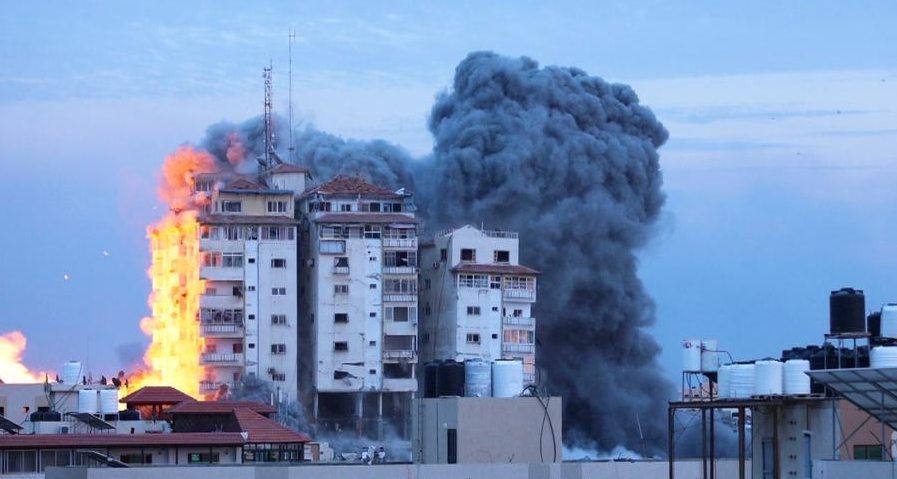
Following the Hamas attacks, Israel retaliated by conducting airstrikes in Gaza, where the UN agency UNRWA operating there had reported significant damage and growing death counts. According to the UN, there have been recent reports of worrisome food shortages and violence along the Israel-Lebanon border. Early on Sunday, the UNIFIL mission in Lebanon reported that it had “detected several rockets fired from southeast Lebanon toward Israeli-occupied territory in the general area of Kafr Chouba and artillery fire from Israel to Lebanon in response.”
In order to reestablish peace between Israel and Lebanon, the UN Security Council authorized mission was sent out in 1978. It operated along the “Blue Line” region. In order to control the situation and prevent a more serious escalation, UNIFIL stated in a statement that it was in communication with authorities on both sides of the Blue Line at all levels. “Our peacekeepers continue to work in their assigned positions.” Peacekeepers continued to work, according to UNIFIL, “some from shelters, for their safety.”
In order to prevent a rapid deterioration of the security situation, the mission urged everyone to display restraint and use UNIFIL’s liaison and coordination procedures to de-escalate. Meanwhile, according to a social media post by his office, UNSCO, Tor Wennesland, the head of the UN’s Middle East Peace Process, “is in close contact” with the US, the EU, Qatar, Egypt, and Lebanon “to discuss the ongoing war” in Israel and Gaza.
The UNSCO tweet stated that the “priority now is to avoid further loss of civilian life and deliver much-needed humanitarian aid to the Strip,” adding that the “UN remains actively engaged to advance these efforts”. Meanwhile, senior UN officials have demanded that violence stop right away. According to UN Spokesperson Stéphane Dujarric, UN Secretary-General Antonio Guterres on Saturday condemned the attack by Hamas against Israeli cities “in the strongest terms” and urged “maximum restraint” and that “all diplomatic efforts” be taken “to avoid a wider conflagration.”
In a statement, the head of the UN emphasized that “citizens must be respected and protected in accordance with international humanitarian law at all times.” According to the World Food Programme (WFP), distribution networks have been badly interrupted and production has been significantly affected by hostilities, making it increasingly difficult for civilians, notably vulnerable children and families, to acquire basic food supplies as the conflict worsens. The World Food Programme (WFP) urged “safe and unhindered humanitarian access to affected areas, calling on all parties to uphold the principles of humanitarian law and taking every necessary step to safeguard the lives and well-being of civilians, including ensuring access to food,” in a statement.