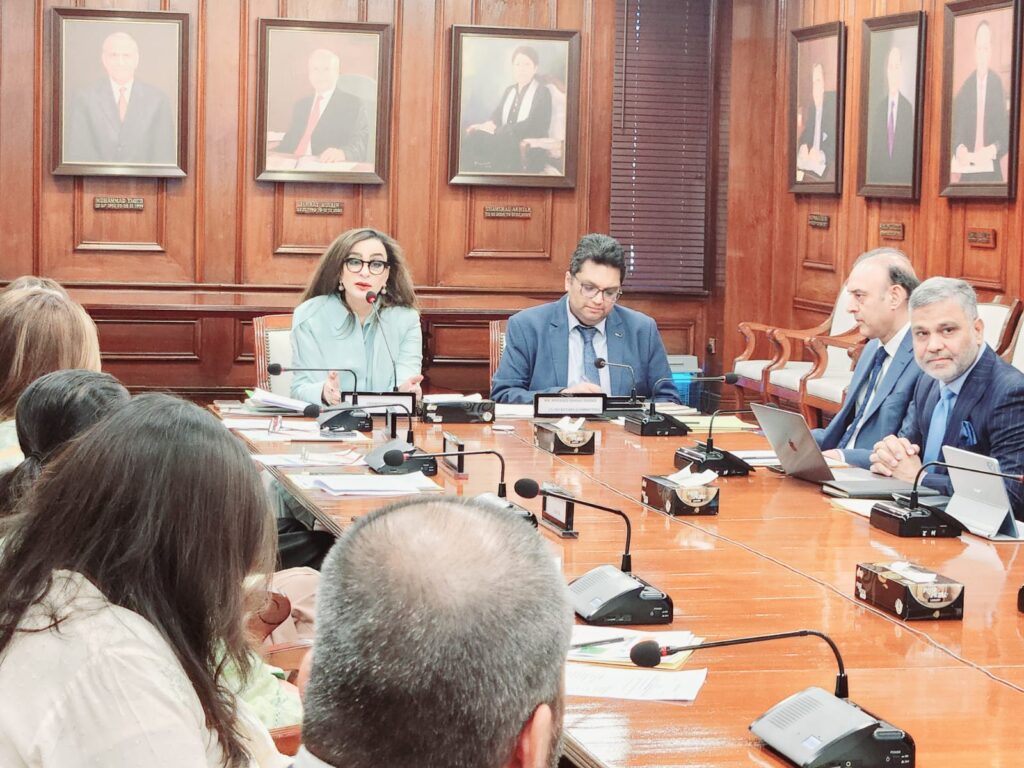
*Karachi, :Senator Sherry Rehman chaired a meeting of the Senate Standing Committee on Climate Change, with agenda focusing on a briefing by the Governor of the State Bank of Pakistan (SBP) on Green Taxonomy.
Senator Rehman opened the session by underscoring the urgency of transitioning towards sustainable economic practices, emphasizing that Green Taxonomy will provide a standardized framework for businesses, corporates, and policymakers. “Green Taxonomy is going to build a common sustainable language for all of us—for businesses, for corporates, and for all sectors that need to comply. In reality, what’s needed is a dictionary for sustainability, ensuring that businesses align their practices, supply chains, and financial activities with climate-resilient frameworks.”
The Governor of SBP highlighted progress on Green Taxonomy in collaboration with the World Bank. He noted that 50 countries globally, including 14 in Asia, have already developed taxonomies. “We have made good progress with Green Taxonomy, our framework is globally aligned and has undergone a consultative process,” he stated. He further explained that taxonomy classifies activities into three categories which are the Green activities that contribute to climate mitigation or adaptation; Amber activities are transitioning towards sustainability, and Red activities do not comply with sustainability standards.
Senator Rehman pushed for clarity on how sectors such as energy, manufacturing, transportation, waste management, and agriculture would comply with the framework. “For agriculture and disaster resilience, you must have an inventory of mitigation and adaptation activities. Please share this inventory in a soft version so that we can track how these measures are being implemented.”
Provincial engagement emerged as another key concern. Senator Rehman emphasized that without provincial governments on board, the Green Taxonomy would remain ineffective. “This implementation must be taken to the provincial level. The Council of Common Interests (CCI) must be engaged to ensure chief ministers and provincial authorities are aligned. Without their ownership, this will stay on paper,” she cautioned.
Senator Rehman also called for targeted awareness campaigns, stressing that sustainable policies must be communicated effectively at the grassroots level. “MOCC&EC, please take note—awareness campaigns need to be built at the grassroots level, especially for agriculture. Farmers must be engaged in their language, with practical approaches such as smart farming. We cannot afford to let a lack of awareness stall progress.”
Senator Quratulain Marri reinforced the importance of effective communication, stating, “Agriculture is the backbone of our economy. How do we make sustainability incentives understandable for farmers and rural communities? “
Senator Rehman also raised critical questions about compliance enforcement, asking, “Will compliance be voluntary or mandatory? What will be the cut-off timeline for industries? How will government departments be held accountable for ensuring adherence to sustainable practices?”
The discussion touched on strengthening Environmental Protection Agencies (EPAs). Senator Rehman pointed out their lack of enforcement powers, proposing they be equipped as regulatory bodies. “Our EPAs are not empowered. We need to rethink how environmental regulations are enforced. If we want to ensure compliance, EPAs must have the authority and resources to act,” she argued.
Senator Taj Haider supported the proposal for legislative measures to regulate emissions, emphasizing that the government must lead by ensuring sustainability in its own operations.
Senator Rehman underscored the need for alignment with global regulatory frameworks, such as the EU’s Carbon Border Adjustment Mechanism (CBAM). “Without proper alignment, our key export sectors like cement, chemicals, and textiles could face significant trade barriers. We must proactively engage with global standards to ensure that Pakistan’s industries remain competitive”. She emphasized that compliance with EU CBAM could drive Pakistan’s transition towards greener production processes, reducing carbon emissions while opening avenues for climate financing and sustainable trade incentives.
On the financial implications of Green Taxonomy, Senator Rehman stressed the need for green financing to attract private sector investment. “The only way to get decision-makers and policymakers interested is through the financing window. If we don’t provide financial incentives, the private sector will not rush into compliance. Public funds are already constrained, and with several international donors pulling back, we must look inward for solutions.”
Addressing pollution concerns, Senator Rehman pointed out that the Indus is the second most polluted river in the world, with plastic waste being dumped in massive quantities. She called for integrating compliance mechanisms into Green Taxonomy to tackle such environmental crises. “We need a scalable and practical approach,” she urged.
On single-use plastics, she pointed out that while bans exist in Islamabad and Sindh, implementation remains weak. “Regulation has to work for citizens. Single-use plastics are cheap and widely used, making enforcement difficult. Recycling is a myth—globally, only 9% of plastics are recycled, and in Pakistan, it’s only 1%. In 2021, toxic waste was being dumped on our shores, but through policy intervention, we stopped issuing NOCs for such waste disposal without regulation. Now, hazardous waste is fully regulated.”
Concluding the meeting, Senator Rehman proposed an online compliance portal for Green Taxonomy to ensure transparency and access to information. “Compliance and disclosure must be incentivized. This is an evolving discussion, but one thing is clear—Pakistan must take ownership of this transition. If we want structural change, it has to be driven from within, with provinces playing a key role in execution,” she stated.
The meeting was attended by Senators Dr. Zarqa Suharwardy, Quratulain Marri, Bushra Anjum, Taj Haider, the Governor of the State Bank of Pakistan, Mr. Mughees Ahmed Shaikh (Joint Secretary, Ministry of Communication), Secretary MoCC&EC via zoom, officials from MoCC&EC, SBP, Ministry of Finance, OICCI and PBC representatives, along with other key dignitaries.