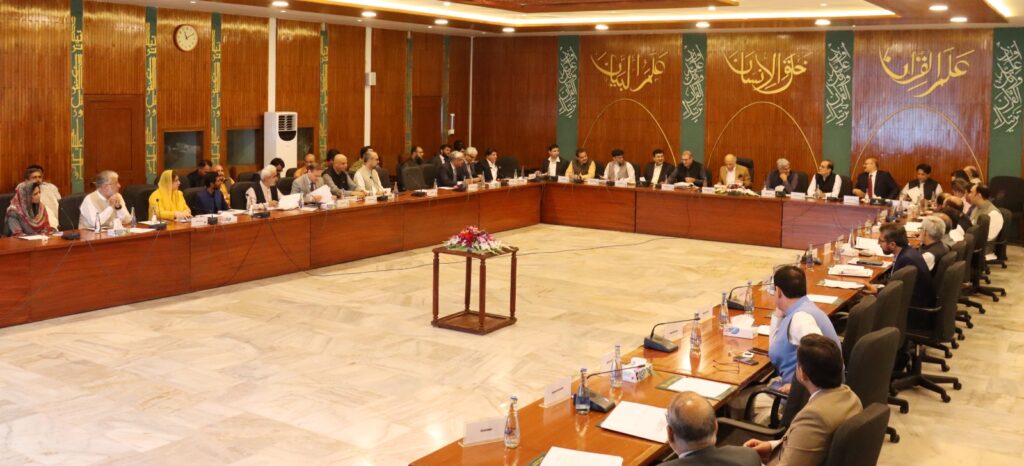
Islamabad – The Meeting of the Annual Plan Coordination Committee (APCC) held under the chairmanship of the Deputy Chairman, Planning Commission and approved the Public Sector Development Program (PSDP) at Rs 1221 billion for the upcoming fiscal year 2024-25. The officials of Federal Ministries/Divisions, Provincial Governments and State Bank of Pakistan attended the meeting.
The APCC noted that Ministries/Divisions initially requested over Rs. 2.8 trillion for projects. However, due to fiscal constraints, the essential funding requirements were discussed with the Ministry of Finance. Consequently, the provisional size of the PSDP was set at Rs. 1221 billion. The formulation of the PSDP faced several challenges, including rising throw-forward, additional demands and provincial projects of devolved nature.
The forum was apprised about the challenges faced in formulation of PSDP for the fiscal year 2024-25. The major challenges included;
Thin spreading of PSDP allocation and rising throw-forward:
Rising throw-forward exacerbates challenges in prioritizing and completing ongoing projects.
Significantly high demand for rupee cover against Foreign Exchange /Foreign Aid component:
Additional demands for post-flood 2022 rehabilitation efforts and implementation of 5Es initiatives aimed at economic recovery and resilience.
APCC advised Ministries/Divisions to prioritize core national projects, foreign aided projects, fund projects with high expenditures for timely completion, prioritize federal, clear pending liabilities. PSDP formulation process was guided by NEC and SIFC recommendations/directions. Following adjustments, the proposed PSDP for 2024-25 was slightly modified, with specific allocations detailed for various sectors.
The sectoral strategy of the proposed PSDP 2024-25 includes allocations for infrastructure development and promoting industrial linkages, energy sufficiency, augmenting water resources, improving transport and communications, emphasizing social sectors, science and IT, governance, production sectors, and ensuring balanced regional development.